use j/k or left/right arrow
to navigate through the photos below
Prasat Phanom Rung
This is one of the finest examples of ancient Khmer architecture still found in Thailand, and was built from the 10th to the 13th centuries at one of the stops on the road running from Angkor to Banteay Chhmar to Buriram to Phimai in Nakhon Ratchasima.
The name seems to mean a Vast Mountain, which is appropriate for a temple which seeks to be like Mount Meru, and is built atop an extinct volcano. It was begun by King Narendrāditya of the Mahidharapura dynasty, who was a descendant of the founder of Angkor Wat.
The temple is dedicated to Śiva, but it fairly ecumenical in its portayals of Hindu mythology, and Viṣṇu and his incarnations as Kriṣṇa and Rāma are also portrayed. Other lesser gods, like the Sun and the Moon, and the nāgas also find their place in this sanctuary.
The temple is one of the stops along a road which ran from the main Angkor Thom, past Banteay Chhmar, and eventually to Phimai, at one of the farthest reaches of the Khmer Empire inside Thailand in Isaan. All of these places seem to have been related and in touch with each other.
The Approach Road
One of the outstanding features of the historical site at Phanom Rung is the very long approach road, running for several hundred metres leading up to the small hill, atop which sits the main site. This would have been used as a processional path during important state functions, and would serve to prepare the participants for their roles and duties in the temple. The pathway is built mainly of laterite stone, which would have been abundant locally. There are 70 small pillars with lotus buds on their tops along the way.

The Dressing Room
To the right of the stairs at the top of the path is the ceremonial dressing room, where the participants would have got ready, before starting the procession. The building has collapsed on one side, leaving the pillared hall exposed.


The Stairway
The temple is built over a small hill, and there is a fairly long, but sloped climb to enter the main sanctuary area. While ascending one crosses the first of three cruciform nāga bridges, which face all four directions. The nāgas serve to protect the sacred area, and establish a sense of awe. This also marks the passage from the mundane world to the heavenly world of the gods.


The Main Enclosure
Once the stairs have been surmounted there is a view of the main temple, which is enclosed by a walled gallery, and has two more nāga bridges to pass over, and a number of lotus ponds. The galleries serve to further define the central space, where the main temple sits.


The Nāgas
The stone nāga statues are very finely carved, and also quite large, standing about as high as the visitor to the site. They have very fine decoration and are five headed, with the central head being the largest. They face the four directions, and are seen on three bridges marking the ascent to the main building.


The Pediments
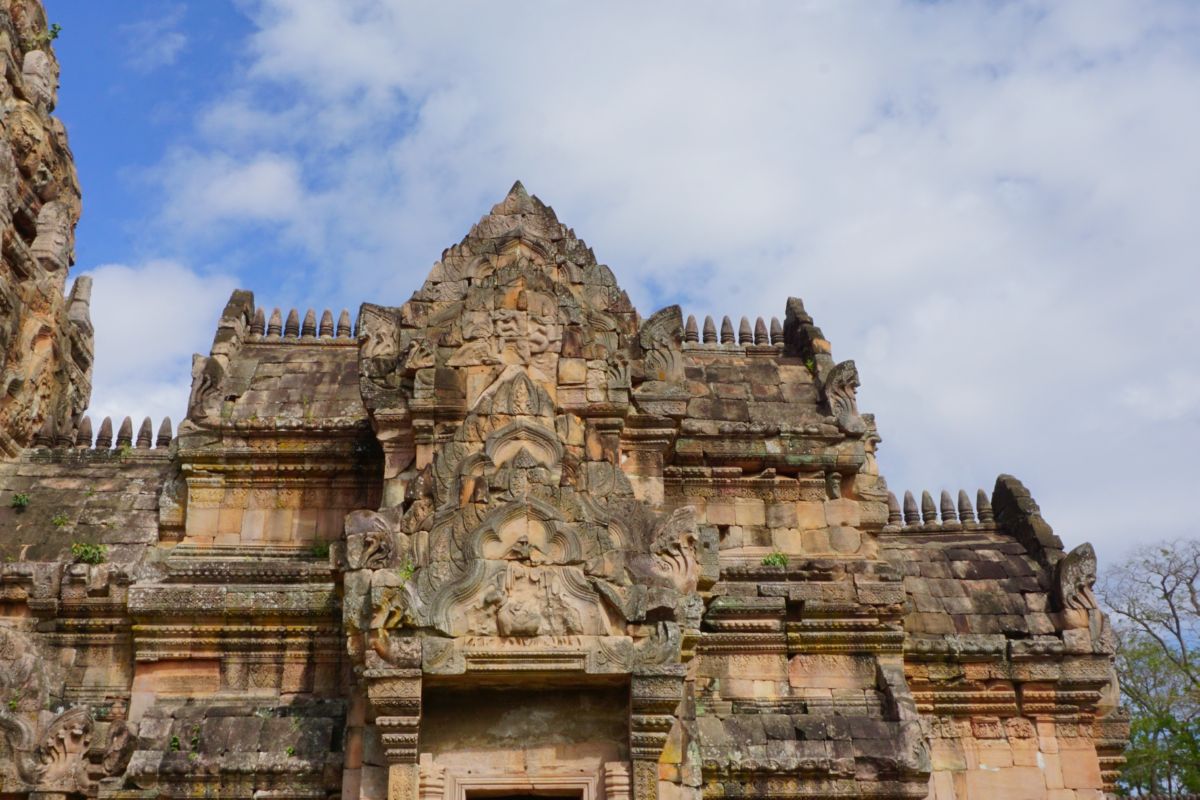
The pediments, which stand above the various doors leading into the monument and the temple were finely carved, but they have evidently fallen down over the centuries, which has damaged them, and the reconstruction has been only partially successful. They mainly show scenes from Hindu mythology, and they show a broad range of Hindu gods. Some are only decorative in nature. They are mainly carved from pink sandstone, as is the main temple itself.


The Main Temple
The main temple was dedicated to Śiva, and is a fine example of the tower-like temples built by the Khmer, which had a central influence on the development of the Thai temple also.


The Approach Road
More views of the causeway leading to and from the temple, which gives some idea of its length, and also the setting, which is in a beautiful and well-tended park.