The Tun-huang Paintings and their Place in Buddhist Art
An Introductory Essay by Laurence Binyon
I
The paintings and drawings here reproduced are a selection from the mass of precious material discovered by Sir Aurel Stein, and brought away by him from ‘The Caves of the Thousand Buddhas’ at Tun-huang [Dunhuang], on the extreme western frontier of China. The romantic circumstances of the discovery have been fully described by Sir Aurel in the second volume of his Ruins of Desert Cathay; and to those pages the reader is referred. But it may be well to recall briefly the main facts of the narrative.
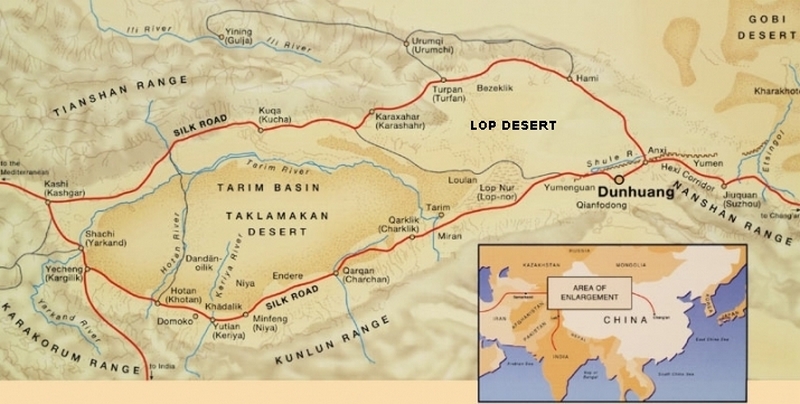
In March 1907 Sir Aurel Stein’s expedition, which had left Kashmir in April of the preceding year, arrived at Tun-huang. From Kashgar the travellers had proceeded to Yarkand; thence to Khotan, where Sir Aurel on his previous journey in 1900-1 had disinterred such interesting remains of the ancient civilization once flourishing in that region; thence eastward along the southern skirts of the great desert, exploring various sites by the way with rich results, till at Tun-huang they found themselves at last within the western border of the Chinese province of Kan-su [Gansu].
Tun-huang is a square-walled town in a prosperous oasis of the desert. Sir Aurel Stein had been attracted thither by the knowledge that near the oasis were a number of sacred grottos known as ‘The Caves of the Thousand Buddhas’, filled with ancient Buddhist frescoes and sculptures. For the wall-paintings and sculptures of the cavetemples of Tun-huang, see now the fine reproductions in M. Paul Pelliot’s Les Grottes de Touen-houang, Peintures et Sculptures des epoques des Wei, des T’ang et des Song (Paris, Paul Geuthner, in progress). But after arriving at Tun-huang, he also heard, through a Muhammadan trader, rumours of something still more exciting to the archaeologist – a hidden deposit of manuscripts which had been accidentally discovered a few years previously in one of the caves. In a barren valley to the south-east of the town, above a narrow strip of irrigated soil, with rows of elms and poplars, there is a cliff of conglomerate rock, which is honeycombed with hundreds of cavities. These have been hollowed out to serve as Buddhist shrines, still frequented by pious worshippers; and the walls of the cellas are covered with old frescoes.

It was in one of the larger shrines that the deposit of manuscripts had been discovered by the Taoist monk [Rev. Wang Yuanlu] in charge of certain grottos. The monk had collected money from the faithful, and had undertaken to restore this particular shrine to its former splendour; a laborious work, since the drifting of the sand and falls of crumbling rock had here, as in many other cases, blocked the entrance of the cave, and the sand and debris had to be cleared away before the actual work of the restorer could begin. While the men engaged on this labour were at work, they had noticed a crack in the frescoed wall of the passage between temple and antechapel. An opening was found; and this led to a recess hollowed out of the rock behind the stuccoed wall. The room thus disclosed proved to be completely filled with rolls of manuscript. Specimens had been sent to the Viceroy of the Province, but no steps had been taken to remove them; and in fact when Sir Aurel Stein first arrived at the Caves he found [2] that the deposit was carefully locked away behind a wooden door; and when, after leaving Tun-huang for a month’s journey of exploration, he returned in May, a brick wall had been added to protect the hidden treasure.
The reader must go to Ruins of Desert Cathay for the full account of the stages by which the Taoist priest who guarded the shrines was induced first to show some specimens, and finally to let Sir Aurel carry off a goodly hoard of the manuscripts and most of the pictorial remains.
The cave had been said to contain only MSS.; and bundles of MSS. were there in immense quantities; but on opening one of the bundles Sir Aurel was delighted to find that it contained paintings on silk. The paintings were all, or nearly all, crumpled up. It seems as if they had been hurriedly thrust away in the vault on some sudden alarm, probably of a barbarian raid. And, in fact, on one of the pictures is a votive inscription praying to Kuan-yin for protection against the Tartars and the Tibetans. The position of Tun-huang on the westernmost frontier of China, at the intersection of the great trade-route across Asia, from east to west, with the high road between Mongolia in the north and Tibet in the south, naturally exposed it to incursions and invasions. Internal evidence of dated documents seems to show that the treasure, or at any rate the great bulk of it, was hidden away soon after the close of the tenth century A.D.
To complete the story, we must add that M. Pelliot, the distinguished savant and traveller, paid a visit a year later to the Caves and was allowed to carry off what remained of the paintings and a large selection from the hoard of manuscripts. These are now in the Bibliothèque Nationale and in the Louvre. What was left of Chinese manuscripts was subsequently transmitted by official order to Peking; much being ‘lost’ on the way.
Not till the paintings were brought to London could any real examination of them be made. Each packet had to be carefully opened, and the brittle, dusty silk, sometimes in a hundred fragments, opened out, cleaned, and, where necessary, pieced together. This was done at the British Museum; and it was a labour of years for the staff of mounters attached to the Print Room.
The paintings were carefully cleaned, and the colours were found in most cases to have lost little of their pristine depth and brightness; though where a certain verdigris green was used, it has tended to eat away the silk on which it was laid, a whole figure in some cases having thus disappeared and left only its surrounding outline. Any attempt at restoration or retouching has been scrupulously avoided; but when a painting which is in fragments has been laid down on silk of a neutral tone, and mounted, the eye is easily carried over the gaps, and the main design reappears. Several of the paintings still retain their original borders, usually of a dull mulberry-purple silk. The small banners, of which a great quantity were found, had all originally a pediment-shaped head-piece, and long silk streamers with a wooden weight at the bottom to steady the banner as it hung. These banners are mostly painted on both sides.
The delicate work of mounting and cleaning was done by Mr. S. W. Littlejohn, Chief Mounter in the Department of Prints and Drawings, assisted in later stages by Mr. Y. Urushibara, a Japanese artist and craftsman. Meanwhile the large embroidery picture (Pl. 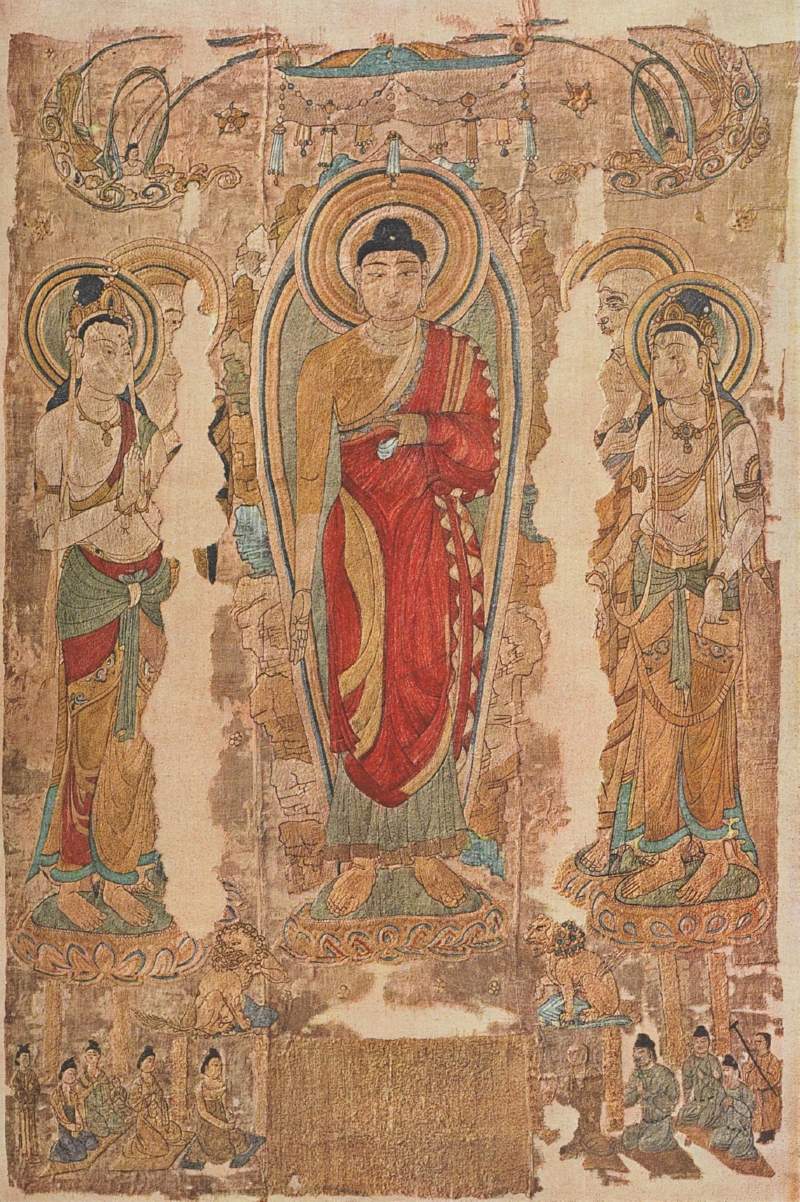
II
The pictorial treasures brought away from Tun-huang by Sir Aurel, and now divided between the Indian Government and the British Museum, consist of votive paintings (mostly on silk, though a certain number are on paper) of various sizes, some being as much as six or seven feet high; of a long series of small banners on silk and larger banners on linen; of one or two magnificent specimens of embroidery, the finest of which is reproduced (Pls. 
The present publication is intended to illustrate the specimens which have most importance for the study of Eastern art.
The paintings and drawings, with a few unimportant exceptions, are all of Buddhist inspiration. At first sight the limitation of scope and the repetition of similar themes may give an impression of monotony. Closer study reveals a remarkable variety. This variety is due to differences of style, which are accounted for partly by the different dates, still more by the different localities at which they were produced, partly by the very varying degrees of skill in the painters who produced them. Being all found in one place, the paintings might be supposed to be all the product of a single local school. But this is certainly not the case, as a brief examination shows at once. There are specimens (of little account as art) which are purely Indian in style and probably Nepalese; there are examples of the well-defined Tibetan type of Buddhist picture; there are paintings which are entirely Chinese; and there are, lastly, a number which contain Indian, Chinese, and possibly Tibetan elements in varying proportions, but are in an intermediate style and may safely be held to be the product of local schools of Chinese Turkestan, and of the region which, on the east, joins it to China proper.
Until a few years ago, scarcely anything was known in Europe of Buddhist painting beyond the famous frescoes of Ajaṇṭā in India and Buddhist paintings by Japanese masters, of which the frescoes in the Horiuji Temple at Nara are among the oldest and most celebrated. It was known that the Japanese modelled their work closely on Chinese tradition; and a few Chinese Buddhist paintings of early periods are preserved in Japan; but while an extensive series of ancient Japanese Butsu-yé exists, corresponding specimens from China are very rare indeed. And if the early Buddhist art of China was little known, still less was known of the intermediate links in the tradition which passed on from India to China through Turkestan. But now, through successive explorations and discoveries, the story of Buddhist art and the phases of its progress eastwards through Asia are fairly plain and familiar. And some of the most illuminating and important documents have been supplied by the discoveries of Sir Aurel Stein.
In the paintings with which we are dealing, the Indian element is obviously very strong, just as ‘The Caves of the Thousand Buddhas’, where they were found, were hollowed out of the cliff in obedience to immemorial Indian tradition: we are reminded at once of the frescoed caves of Ajaṇṭā. But there are other elements besides the Indian, as we shall see.
How did Buddhism penetrate into Central Asia? From India proper it travelled by way of the extreme north-west frontier, the valley of Peshawar, then known as the kingdom of Gandhāra; thence to the countries lying north, and so eastwards by the great trade-route across the desert to China. Gandhāra is the first stage of this long journey: and it was in Gandhāra that the Buddhist art of the Further East, as we know it, was first formulated. The now well-known sculptures of Gandhāra, a fine series of which may be seen in the British Museum, date from about the first century of our era to about the sixth. They represent a late Hellenistic tradition put to the service of the Indian religion. It was in [4] Gandhāra that the types of Buddhist art became fixed. It was there that the type of Śākyamuni himself was first invented, or rather adapted from the ideal forms of Hellenistic sculpture. For some centuries after the Buddha’s death, Indian artists had always refrained from representing the image of the Lord.
The Hellenistic element, apparent in poses, in drapery, in decorative motifs like the acanthus-ornament, tends to become submerged in the later phases of the art, though something of it still persists recognizably in the Buddhist art of remote Japan, even today. At a desert site of Khotan, the little kingdom lying at the southern edge of the Taklamakān Desert, beyond the mountains on the north-Eastern frontier of Ladakh and Kashmir, Sir Aurel Stein found on his first expedition (1900-1) the remains of settlements abandoned to the encroaching sand about the third century A.D. Among these remains were heaps of letters and documents written in early Indian script and language on wooden tablets, tied with string and sealed; and in most cases the seal was a Greek seal, engraved with a figure of Athene, Heracles, or other deity. Again, at Mīrān, a site near Lop-nōr and much further east, Sir Aurel, on his second expedition discovered Buddhist shrines adorned with frescoes of about the fourth century A.D. painted in the style of late classical tradition.
Fascinating as are these traces of Greece and the West in the midst of the Asian deserts, the influence of Hellenism was not profound or formative. India was the main influence on the culture of the cities once flourishing along the chain of oases in the deserts west of China, Buddhism the great civilizing factor, and Gandhāra the source from which the local schools of art drew their inspiration. Gandhāra art was itself not without some admixture from Persian sources; and Iranian motives of decoration are found in these desert sites, as they are found in China itself, just as some of the Tun-huang manuscripts are written in the Iranian dialect called Sogdian. The art of Turkestan is full of mixed influences, the reflection of its civilization.
And what of China? For during the second century B.C. and the two centuries following China pursued a policy of political and military expansion westward, with a view to opening up trade-routes, consolidating her frontiers and protecting them from the ravages of the Huns and other tribes; and Eastern Turkestan became a Chinese protectorate. Though afterwards China’s hold became weakened and her power receded, in the seventh century A.D., under an Emperor of the great T’ang dynasty, the whole region came again under Chinese Government, and the Empire’s political sphere of influence was extended as far as the borders of Persia and the shores of the Caspian. But Chinese influence seems to have been confined mainly to administration, and to have affected but little the culture of the people, though traces of it are discernible in their arts and industries, ever more marked as we go further east.
This way passed the old great high road between east and west, by which the Chinese silks were carried overland to Antioch and the Roman Empire. It was a highway for commerce, but also for ideas and religions. And the early centuries of our era were marked by an extraordinary ferment of mystical beliefs both in east and west. While Christianity and Mithraism were contending for supremacy in the Roman Empire, Buddhism was making its victorious progress eastwards. But it was no longer the simple ethical doctrine preached by Gautama. Mahāyāna Buddhism, as the later development of Buddhism is called – the Great Vehicle, as opposed to the Hīnayāna, or Small Vehicle, of the original doctrine – was first formulated about the first century A.D. It was no longer the salvation of the individual which was the aim of the devout, but the salvation of the whole world, towards which the Bodhisattvas strive unceasingly out of their boundless love for every sentient being. The Bodhisattvas in this new phase of Buddhism became more and more the object of popular worship. They are either men who, having won the right to enter Buddhahood, refuse that peace for the sake of suffering mankind, or else celestial beings who assume a human form. Of this last order of beings is Avalokiteśvara, whom the Chinese know as Kuan-yin, and the Japanese as Kwannon; the favourite object of adoration in Mahāyāna Buddhism. He appears in art both in male and female form. In later art the female form is almost universal, but in the Tun-huang paintings the male form is predominant. Avalokiteśvara is the spiritual son of Amitābhā, the impersonal Buddha, the Light of the Enlightened; and Amitābhā is said to have created [5] a Paradise in the West, where souls who believe in him may be born and rest for a long age, or in popular belief for ever. Śākyamuni, we note, has no longer the supreme position, though sometimes he is painted as reigning over a Paradise, or, as in the large embroidery-picture (Pl.
As Avalokiteśvara is incarnate Pity, so, among other great Bodhisattvas, Mañjuśri embodies the Spirit of Wisdom, Samantabhadra stands for the power of the Church, Kṣitigarbha is the breaker of the powers of Hell and the illuminator of its darkness. Bhaiṣajyarāja is the lord of medicine; and Maitreya is the Buddha that is to come.
Besides the Buddhas and Bodhisattvas, the Lokapālas or Demon Kings who guard each one of the Four Quarters of the World are frequent figures in art. These are survivals of primitive demon-worship adopted into Buddhism.
The subjects of the Tun-huang paintings are, then, single figures of Bodhisattvas, especially of Avalokiteśvara, or of the Lokapālas; small pictures of scenes from Gautama’s life, or the Jātakas, stories of his lives in previous incarnations; and representations of the Western Paradise. This last subject is sometimes highly elaborated, with an immense number of figures of the blest grouped in pavilions and terraces built about a lotus lake. Flowers are rained through the air, and celestial beings dance and sing for the delight of the souls dwelling in the Happy Land of Amitābhā’s creation.
All this carries us far indeed from the Four Noble Truths and the Eightfold Path – the simple doctrine in which Śākyamuni taught the means of Salvation here on earth. Much of this later Buddhism was doubtless an accretion from other faiths with which it came in contact on its progress through Asia. Amitābhā may be a borrowing from the worship of Mithras; and certain of the Bodhisattvas may have been originally deified heroes of lands into which Buddhism made its way. In Eastern Turkestan, Manichaeism, the religion founded by the Persian Mani in the third century A.D., found a home; and at Turfan – one of the oases which have been explored – Manichaeans, Buddhists, and Christians were living peaceably side by side.
For the study of religion, then, the art found in the various sites on the borders of the Taklamakān and Lop deserts is of extraordinary interest. But, as art, it is of a local and provincial type, and though often of considerable merit, it nowhere rises beyond a certain level.
III
But at Tun-huang we are within the frontiers of China proper; and Chinese art during the T’ang period, seventh to tenth century A.D., was at its grandest height of power. The extraordinary interest of these paintings is that, though a great number of them are, as we might expect, obviously provincial productions (e.g. Pls. 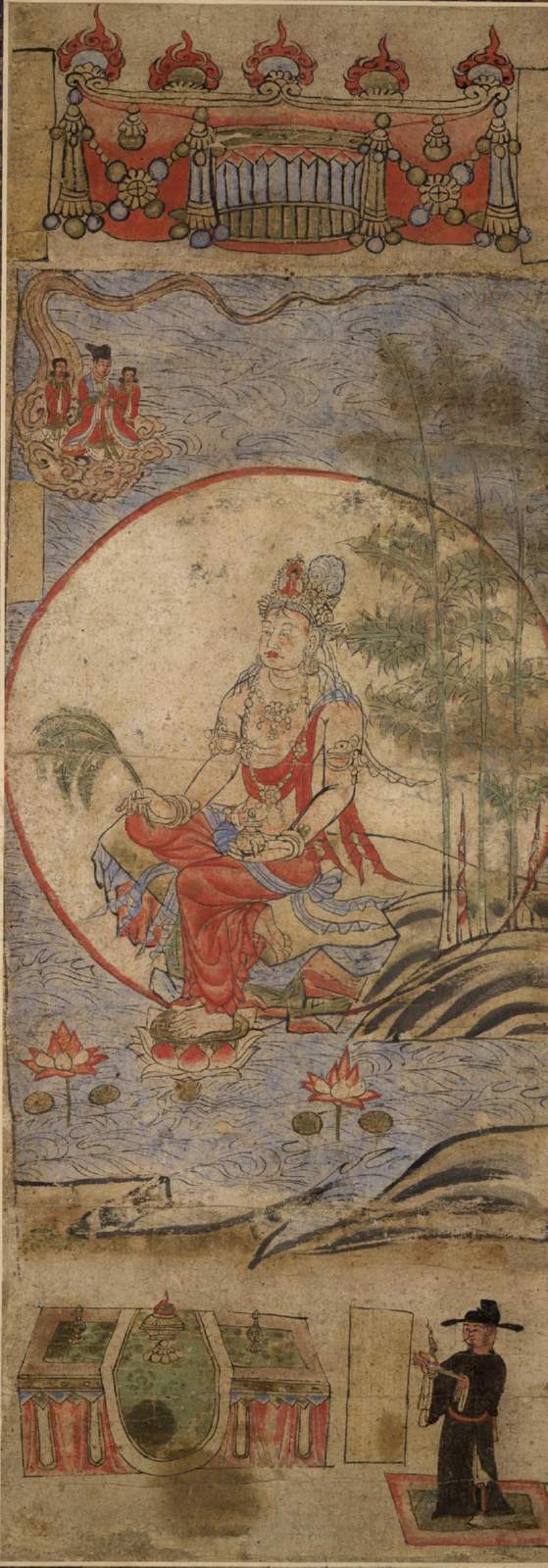
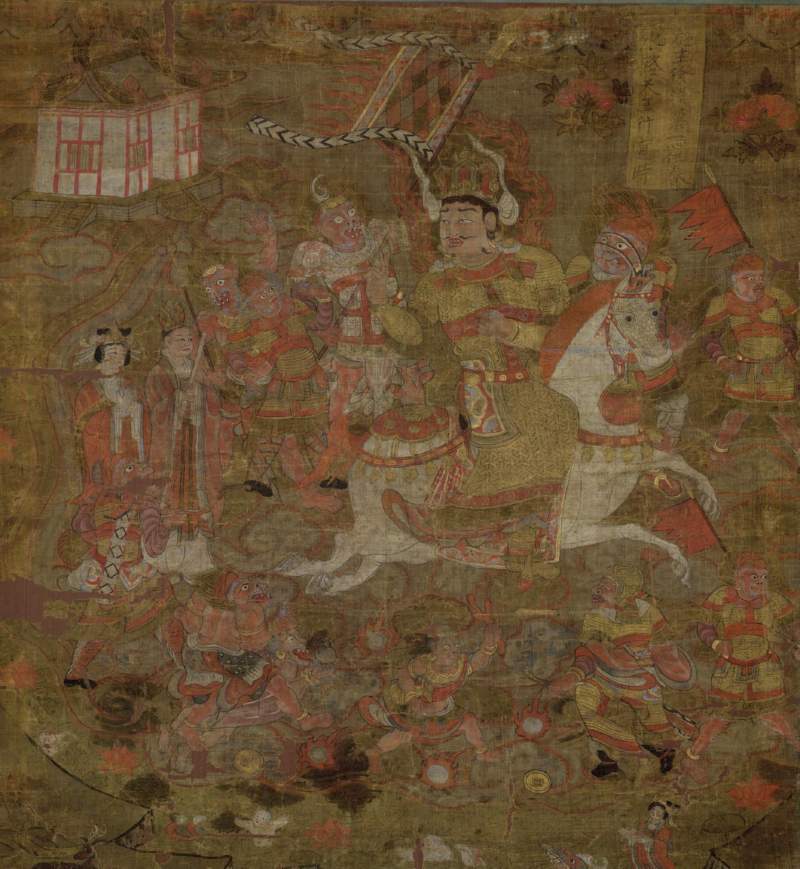
How do we know that these paintings belong to that central tradition? We know it from the early Buddhist paintings of Japan, of which noble masterpieces (some perhaps actually Chinese) are preserved in the Japanese temples. Even if we did not know that the early Japanese painters founded their style entirely on the T’ang masters, the Tun-huang pictures, sometimes so singularly close to the Japanese Buddhist art of the same period, would prove it.

Close up of the Bodhisattvas
Plate 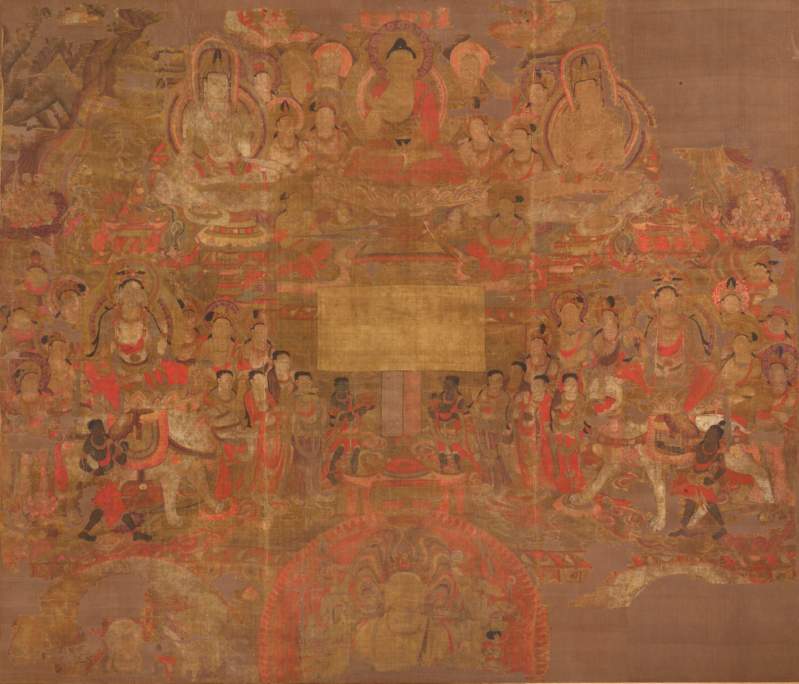
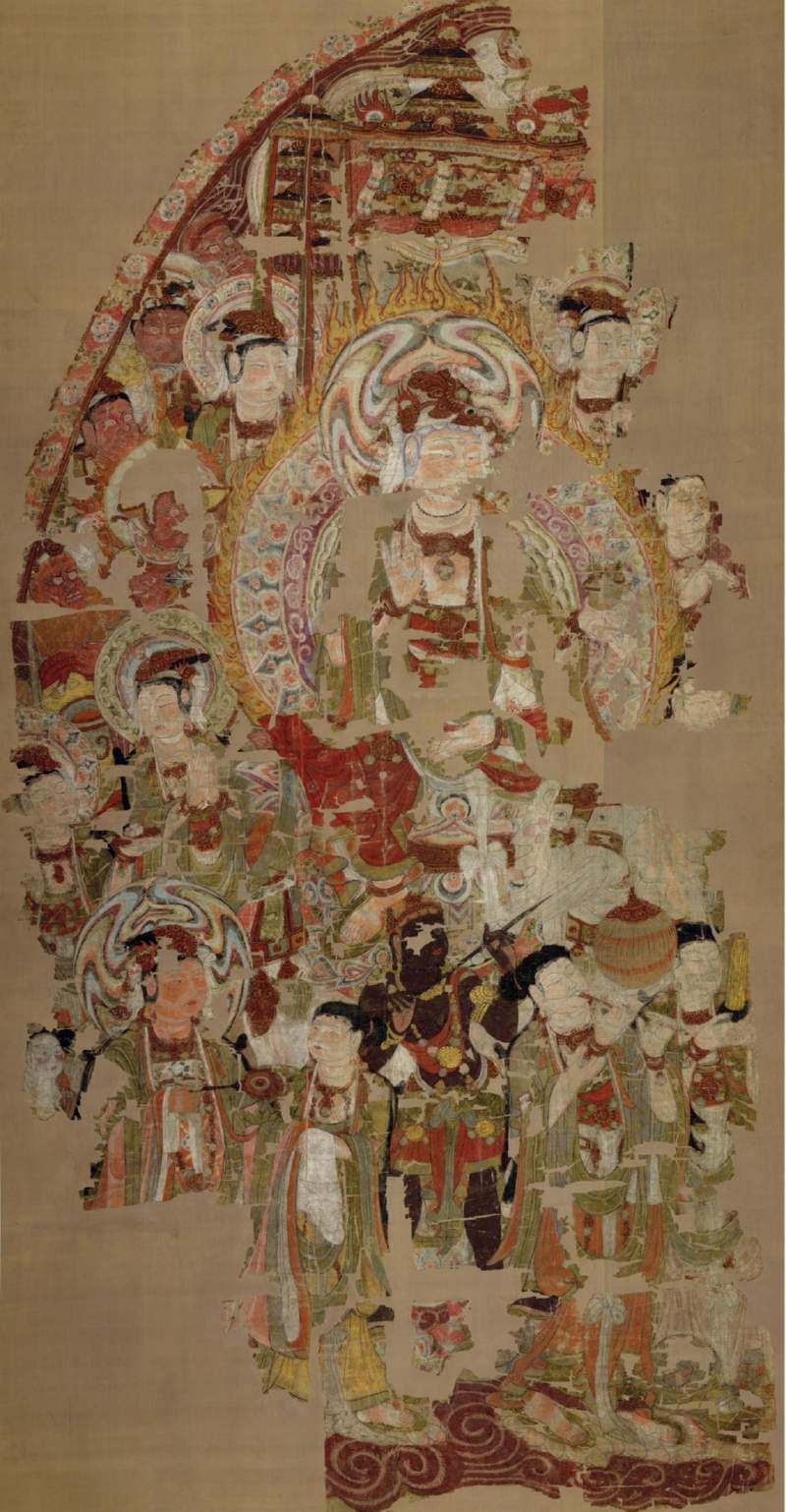
The serene grandeur of the design is enhanced by a pervasion of grace in the delineation of every form. Here, surely, is the hand of a master. Rivalling this in beauty is the large painting of which a [6] portion is reproduced on Plate 
In both of these pictures the artist has been able to control his complex material and multitude of forms into a wonderful harmony, without any restlessness or confusion; and we are taken into an atmosphere of strange peace, which yet seems filled with buoyant motion and with floating strains of music.
None of the other pictures is, as art, quite on this level, the tendency being for the quality of the workmanship to be inadequate to the conception and design. The two grand fragments illustrated on Plates 
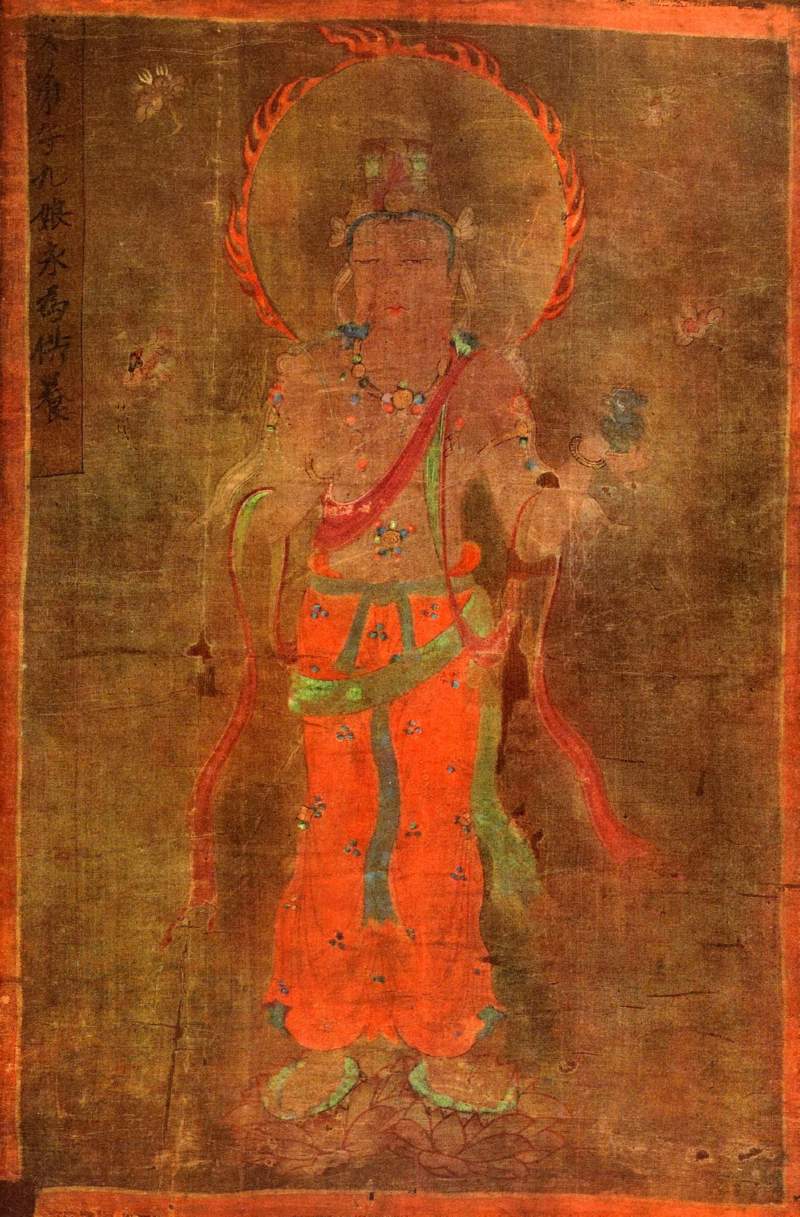


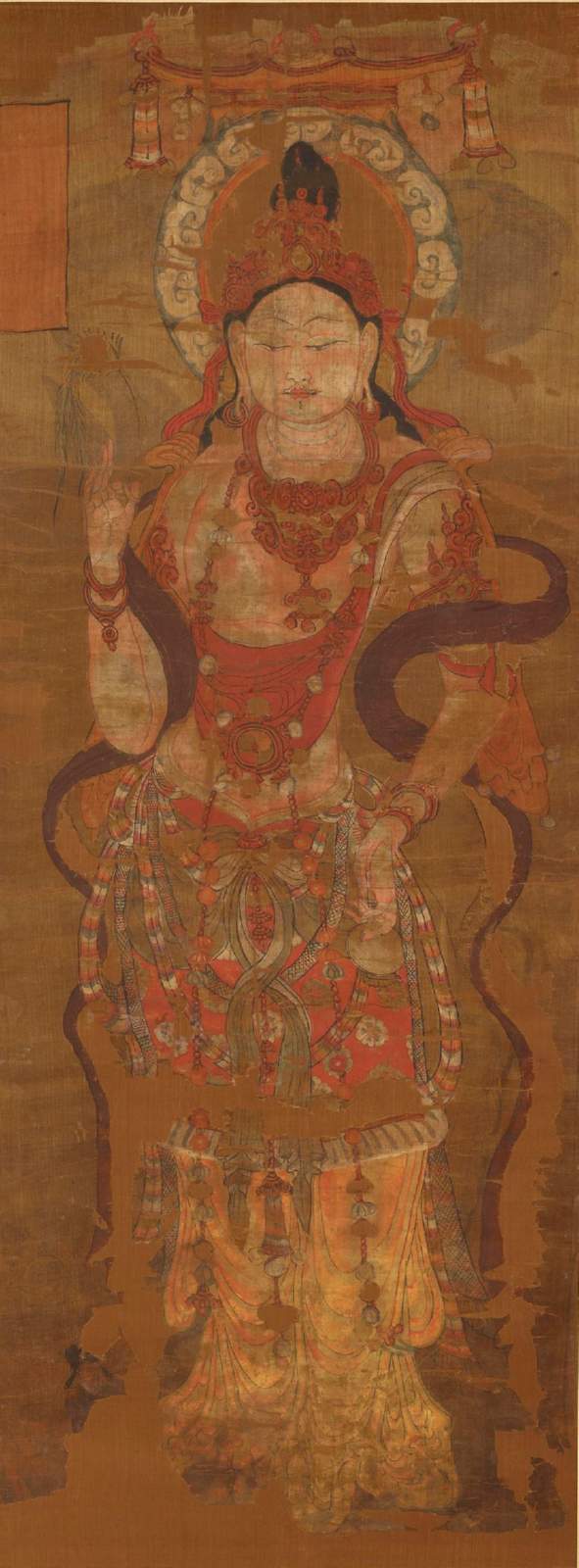
In such a picture as the Two Forms of Avalokiteśvara (Pl. 
This group of paintings gives to the collection found at Tun-huang an artistic importance quite beyond that of any of the groups of works of art discovered by various expeditions in Turkestan; and it is worth while to examine them a little more closely.
The flooding wave of Indian religion and Indian art, after traversing a region of inferior cultures, meets in China for the first time an established art of original power and native genius. The Indian religion, in spite of vicissitudes and rebuffs, takes a firm hold on the Chinese. Buddhist paintings are demanded of the great masters. Of what character is the resulting art?
We are unable to say what the earliest treatment of Buddhist themes by Chinese artists was like. Buddhist images were introduced from India as early as the first century A.D., and were eagerly sought for and studied in succeeding times. Plate 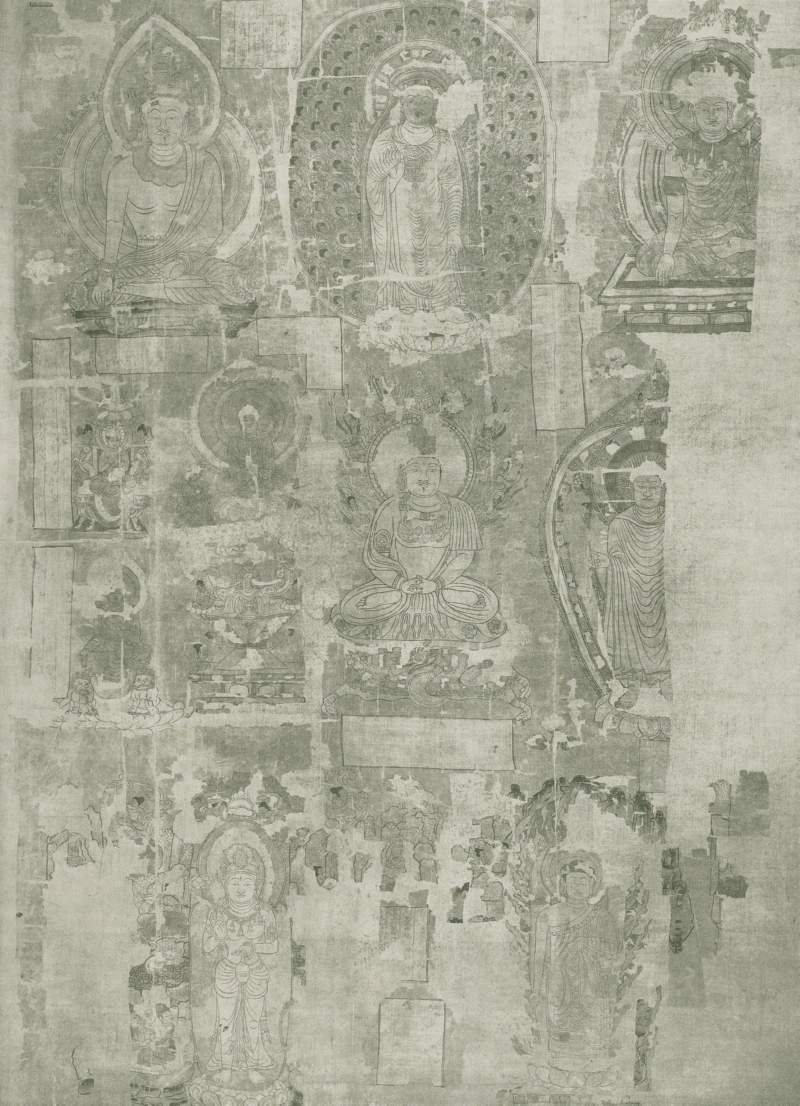
That purely native style is found in the paintings we are examining, but not as a rule in the treatment of the main subjects. Many of the large pictures of Paradise have borders on either side, divided into compartments, in which are painted scenes from the Jātakas or stories of the former lives of Buddha. One is reminded of the predella pictures of an Italian altar-piece. Plate 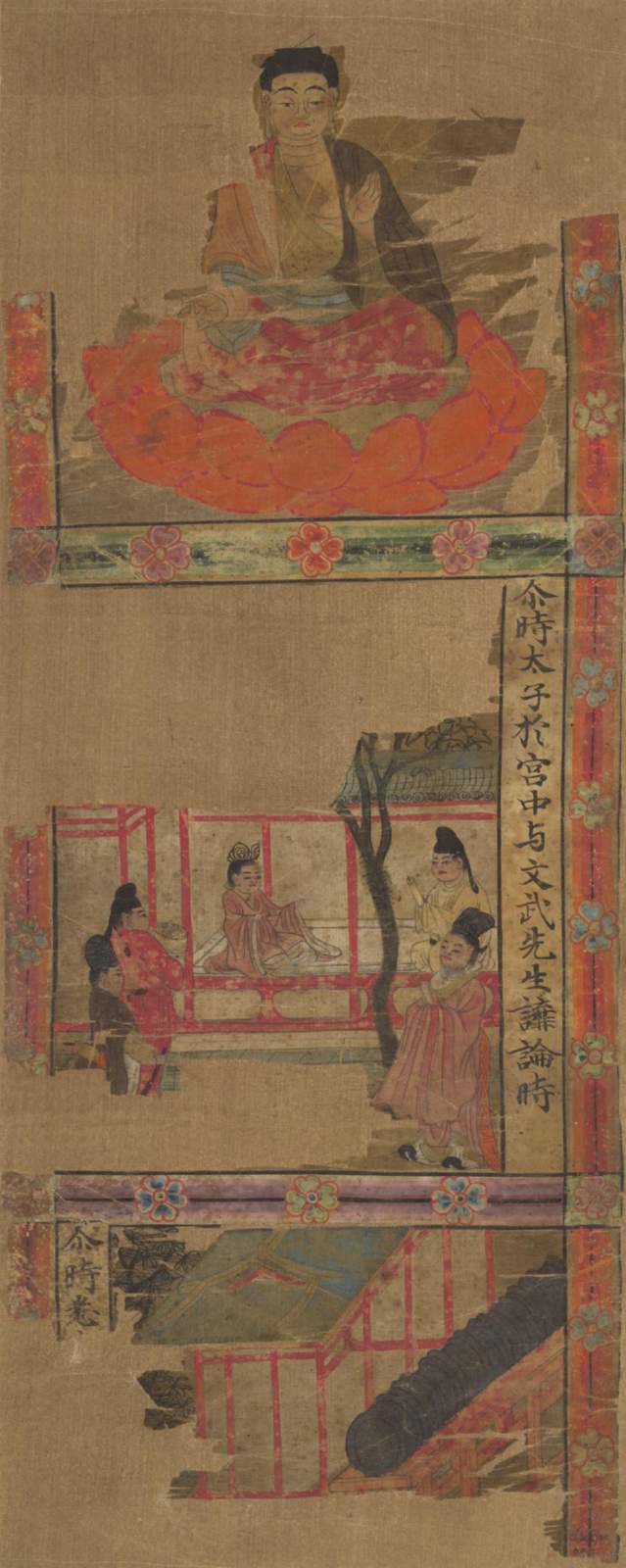
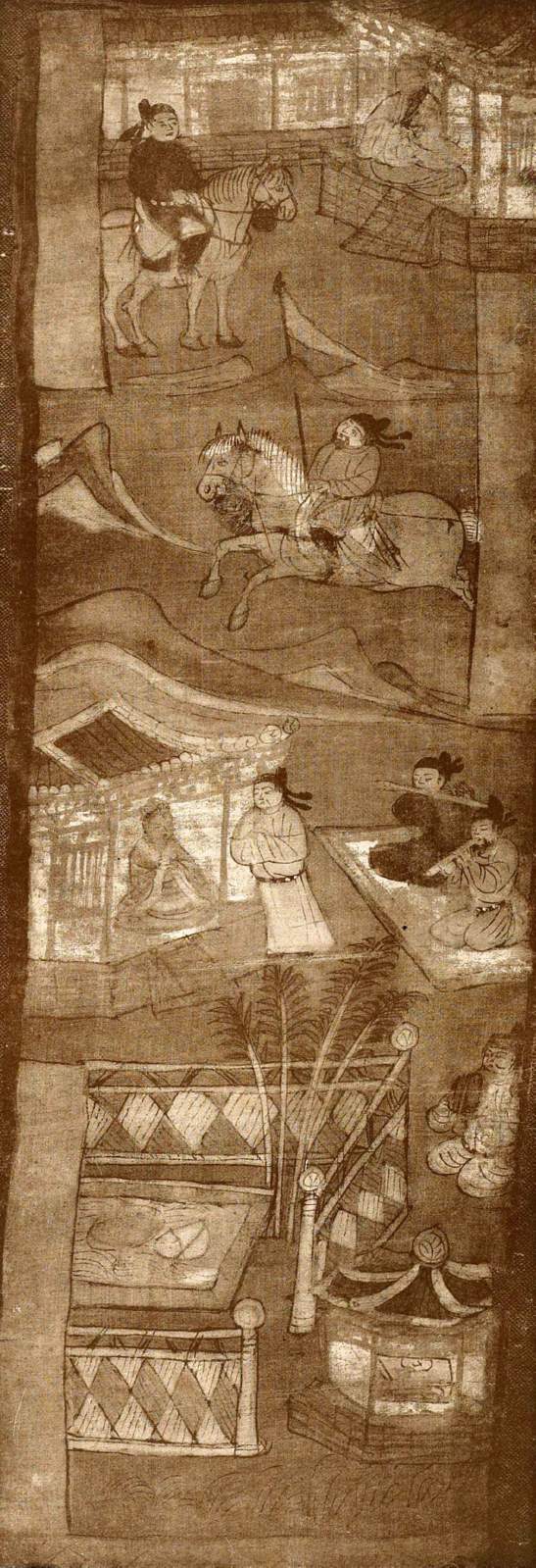
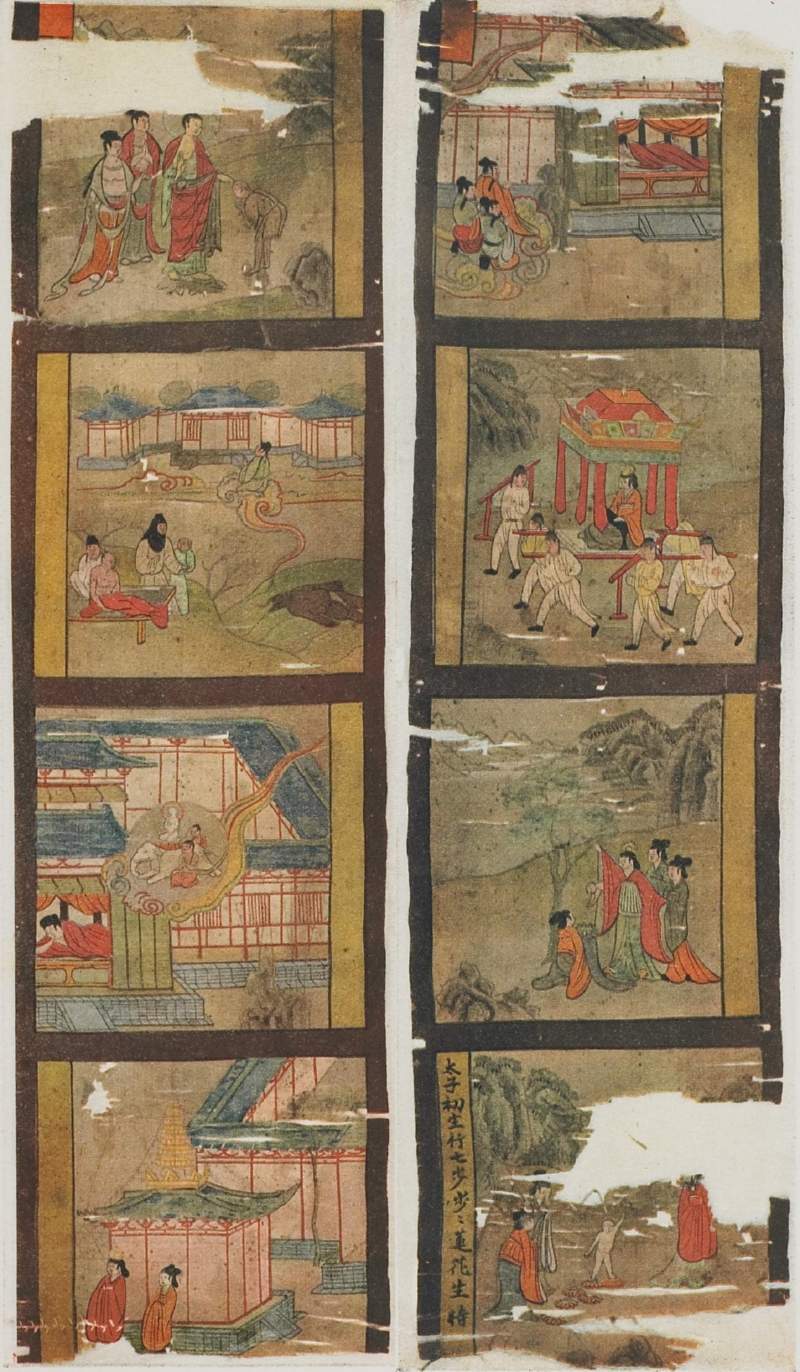
[7] How comes it, then, that in portraying the Buddhas and Bodhisattvas, the saints and Lokapālas or Demon Kings, the Chinese painters follow so closely the Indian formula? We may suppose that just as fifteenth-century painters in Italy and the Netherlands, in representing Gospel scenes, portrayed Christ and his disciples dressed in a conventional, supposedly Oriental garb, but painted secular persons and spectators in the costume of their own time and place, so it was with these Chinese artists. And perhaps this is sufficient explanation. Yet, when we remark what fidelity to Gandhāran models was observed, once the Chinese artists had come to know them; when we remember that the Jātaka scenes were frequent subjects of the school of Gandhāra and were of course treated in the same style as the Bodhisattvas; and when we consider that Buddha himself, in his youth, is portrayed in these banner paintings as a Chinese boy in Chinese dress, we may be tempted by another hypothesis. We may suppose that when the Buddha-legends were first illustrated by Chinese painters they were known by written and oral tradition only, and that the painters, having no models to fall back upon, painted the chosen scenes in their own way and according to their own lights; and this style, this treatment, once fixed, remained. It might be that the tradition thus formed (which, be it noticed, is continued in Japanese art throughout) represents an earlier phase of Buddhism, when the Buddha-legend was more prominent in the mouths of missionaries than the worship of the Bodhisattvas. But all this is conjecture, and the simpler explanation may be the right one.
At any rate, what we have to note is the fact that Chinese painting had already developed a powerful genius of its own, and, however much it borrowed, was able to fuse its borrowings in its own style. But before dealing with this question of the fusion of Indian subject-matter in Chinese style, let us complete what there is to say about the purely Chinese features in the Tun-huang paintings.
Besides the illustrations of Jātaka-legends, there are at the foot of many of the pictures portraits of their donors. These are most valuable documents for the student of Chinese painting; for they give us portraits of people actually living at a certain date, they show us what costume they wore – thereby often helping us to determine the approximate date of undated pictures – and they afford more than a hint of the prevalent style of drawing in secular art.
Every one who has studied the earlier art of China knows how difficult it is to find a really trustworthy starting-point for dating pictures and arriving at a sound conception of the style of a given period. We have usually only an ancient tradition, at the best, of date and authorship. But here we have dated work, from which we can start.
Among the paintings reproduced is one, ‘Four Forms of Avalokiteśvara’ (Pl.
Comparing the picture reproduced on Plate 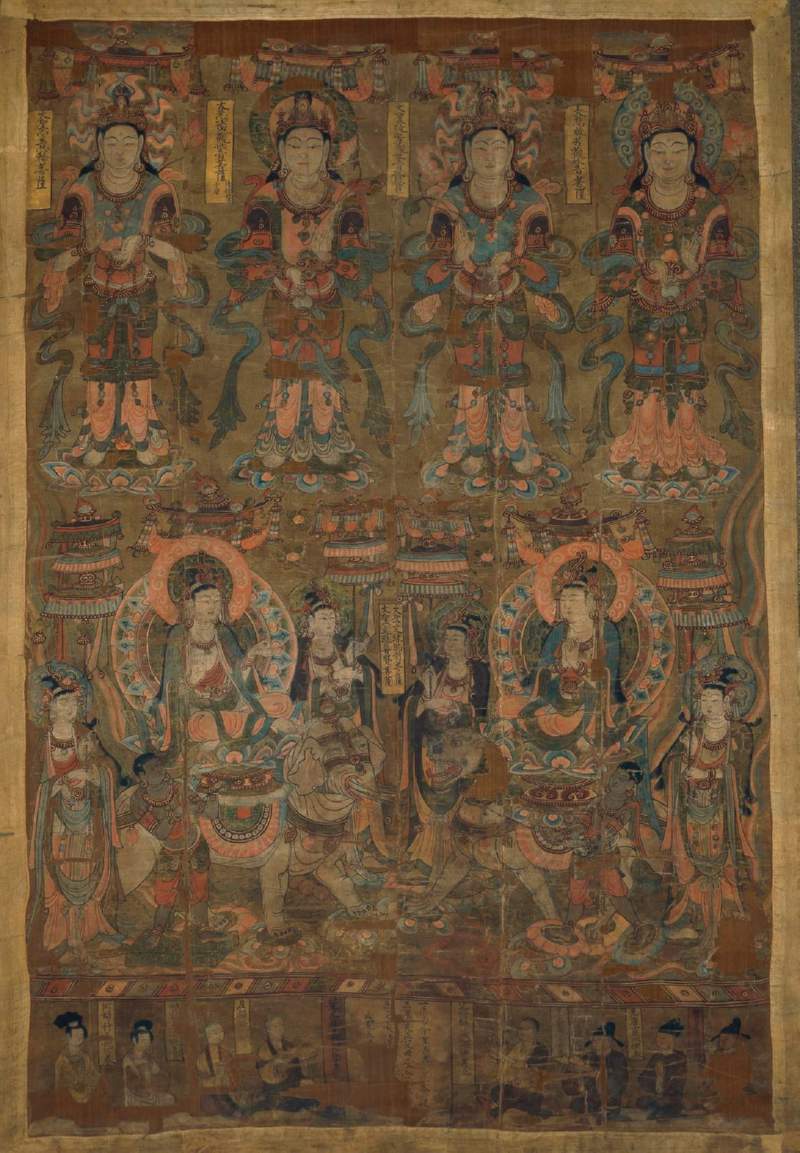
We know nothing certain of Chinese painting before T’ang times, except the painting in the British Museum, ‘Admonitions of the Instructress in the Palace’, and the ‘Ló-shen Fu’ in the Freer Collection, both ascribed to Ku K’ai-chih. Whether either of these be allowed to be an original of the fourth century or not, there can be no doubt that they represent the style of that period in its main characteristics: they show a great mastery of expressive drawing of the human figure, an extraordinary command of finely modulated, sinuous line, a love of it both for its own sake and as expressive of movement, and a quite primitive and rudimentary treatment of landscape.
The paintings we are now considering afford no adequate material for comparison; but one thing is at once noticeable, and that is the altered ideal of the human form; in place of the tall, slender proportions of Ku K’ai-chih, T’ang art substitutes shorter and more massive proportions. An ideal of power has superseded an ideal of grace.
Hints of the treatment of landscape, primitive by comparison with the mature Sung art, but decidedly more advanced than Ku K’ai-chih’s, are also of much interest.
[8] Among the Tun-huang paintings there is at least one (Pl. 
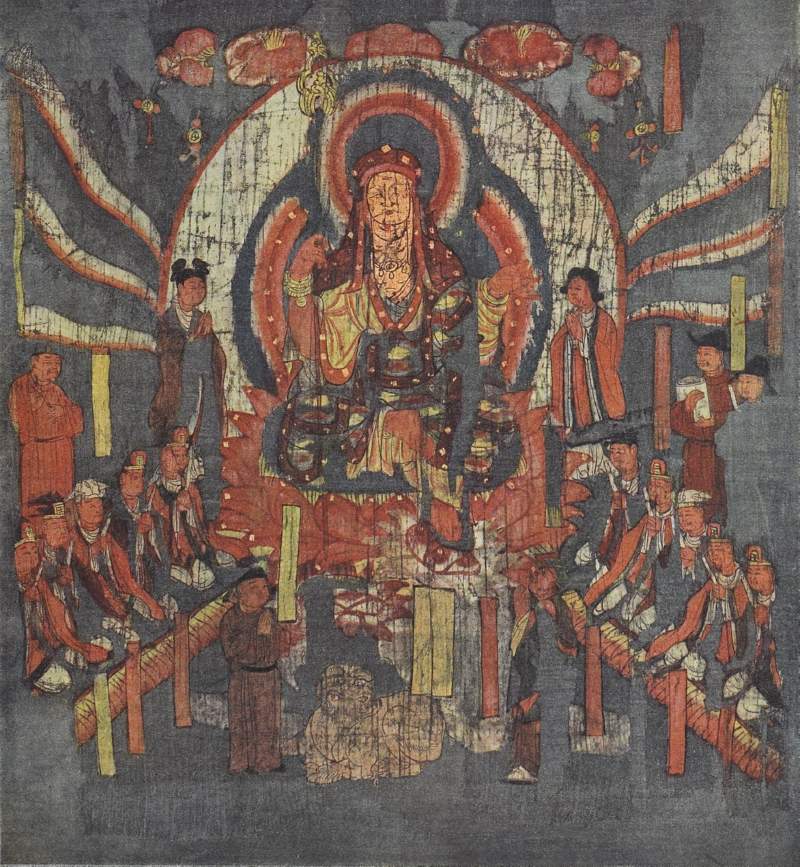
One or two paintings in the collection seem to have been added to the hidden store at a later date. Such is the painting reproduced on Plate 
We may now return to the question of the way in which Indian subject-matter was fused in Chinese style.
As we have seen, the narrative-pictures, depicting episodes from the Jātakas, were originally painted in a purely native manner, the whole theme being bodily translated into Chinese terms; and this tradition persisted, and even in Japan the Buddha legend is given a Chinese dress. But with the devotional pictures it was different. As early as the fifth century, Chinese artists, as we know from the sculptures at Yün-kang, were copying the Gandhāra types of the Bodhisattvas, though, as M. Petrucci has observed, the Gandhāra tradition appears at Yün-kang ‘a l’etat de débris, comme une chose finissante’. We may suppose that the copying of Gandhāra models went on for a time side by side with the complete translation of the Indian story into a Chinese formula. But by degrees the Chinese genius asserted itself; and probably the advent of Wu Tao-tzŭ and a few other men of genius gave a fresh character to the Buddhist art of T’ang.
The Chinese genius is strong just where the Indian genius is weak. The bent of the Indian artist is to pour out his emotions and imaginings in a torrent, shaping them to form and colour as they come; he delights in exuberance and a fine excess; he cannot bear to leave a corner of his space unfilled. If we compare the Ajaṇṭā frescoes with the best of the Tun-huang paintings, say with that partly reproduced on Plate
Look, again, at the small paintings of Jātaka scenes at the side of Plate
In the typical classics of Chinese art these special powers in the control of ordered, fluent line, and in mastery of spacing, are magnificently displayed. But even in these Tun-huang pictures, where the subject-matter, the imagery, and the canons of ideal form are taken over from India, we feel how all this is being fused in the fire of a different genius. And in such a picture as the large Paradise (Pls.
IV
It has been mentioned that a series of Nepalese paintings of Bodhisattvas were found at Tun-huang. These are precious documents, because of the extreme rarity of Indian paintings of so early a period; but as their artistic interest is but slight, they have not been chosen for illustration. Plate 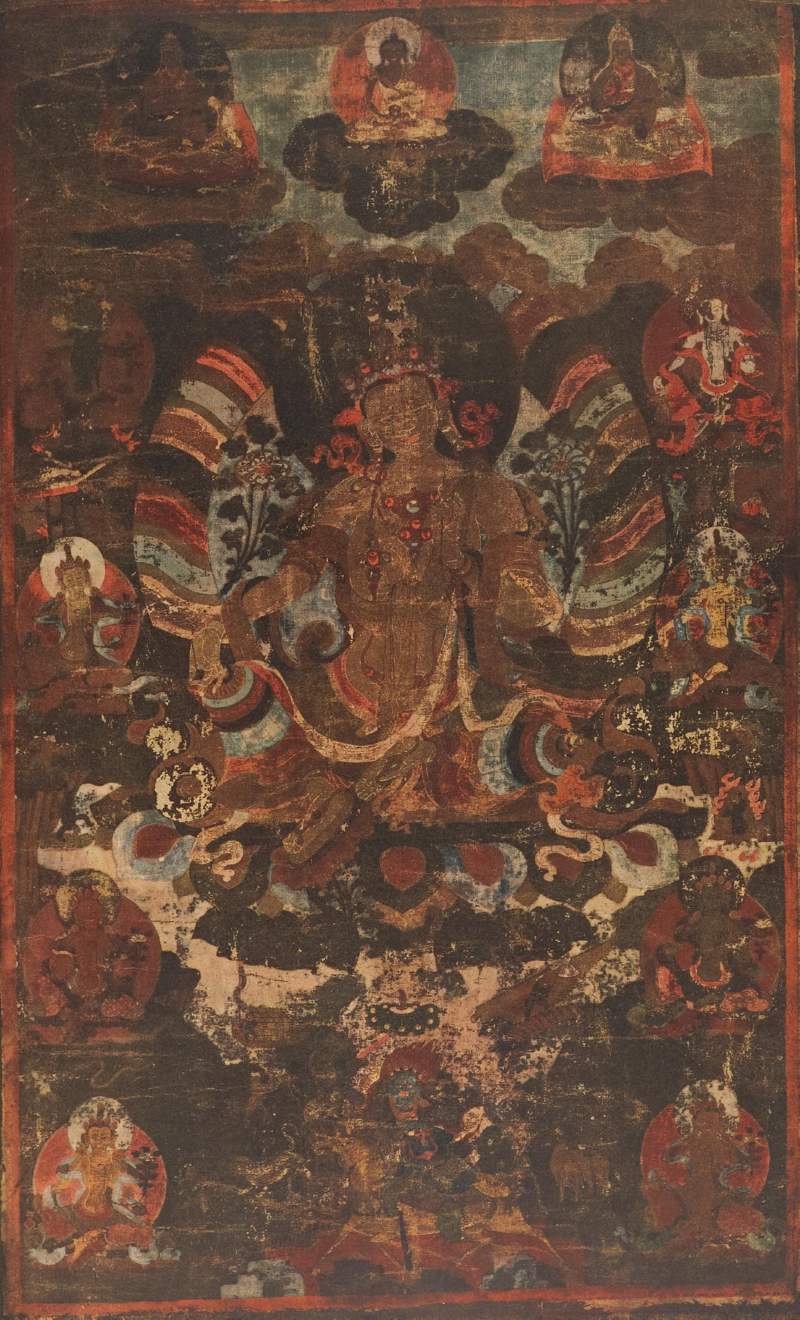
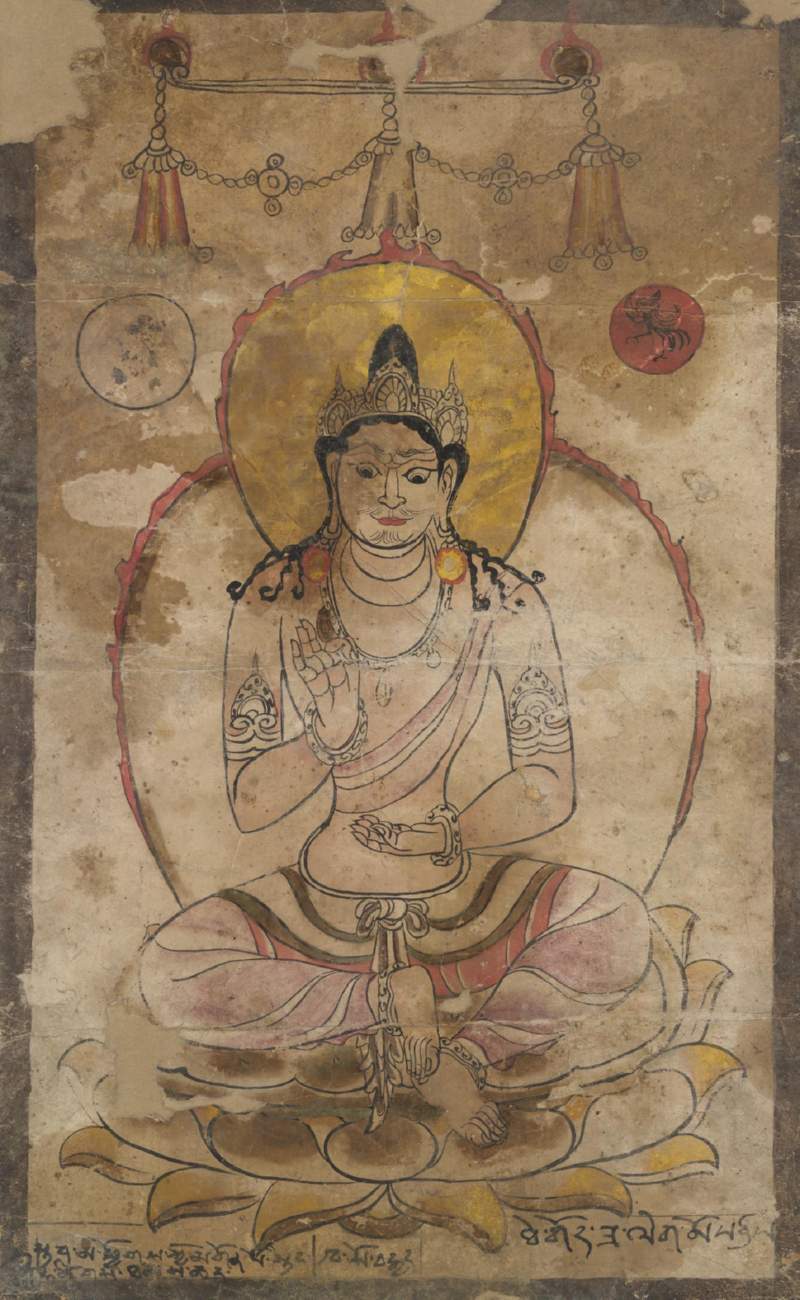
But how did this Tibetan art grow up? What is the indigenous element in it? Buddhism was only introduced into the country in the seventh century, and whether Tibet had any art to speak of before its introduction we do not know. In Tibetan Buddhism the Tantra system of magic and witchcraft, and the worship of demons (supposed to be converted by Buddha and to be vassals under his sovereignty), play a dominant part; and in the paintings the forms are often monstrous and horrible, the colouring sombrely splendid. But the harmonies of fluid, sinuous line, for which they are even more remarkable, seem to be an element borrowed from Chinese art and carried to excess in Tibet. If we compare for a moment this painting with, for instance, the one reproduced on Plate 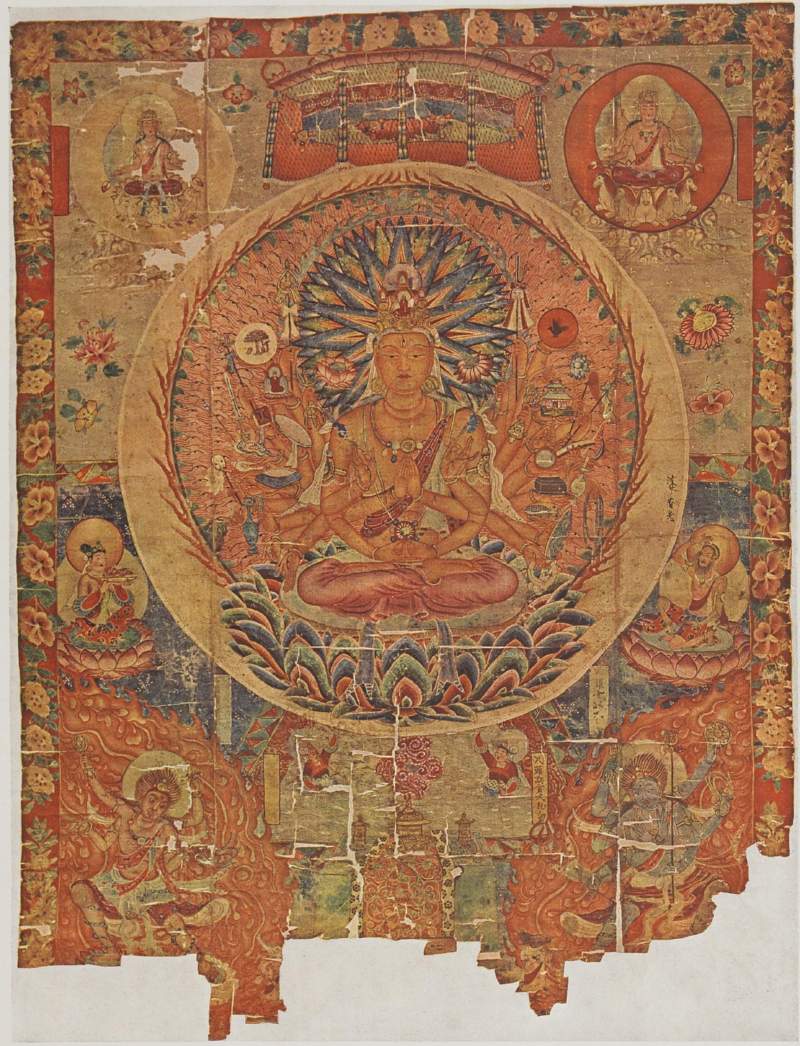
Plate 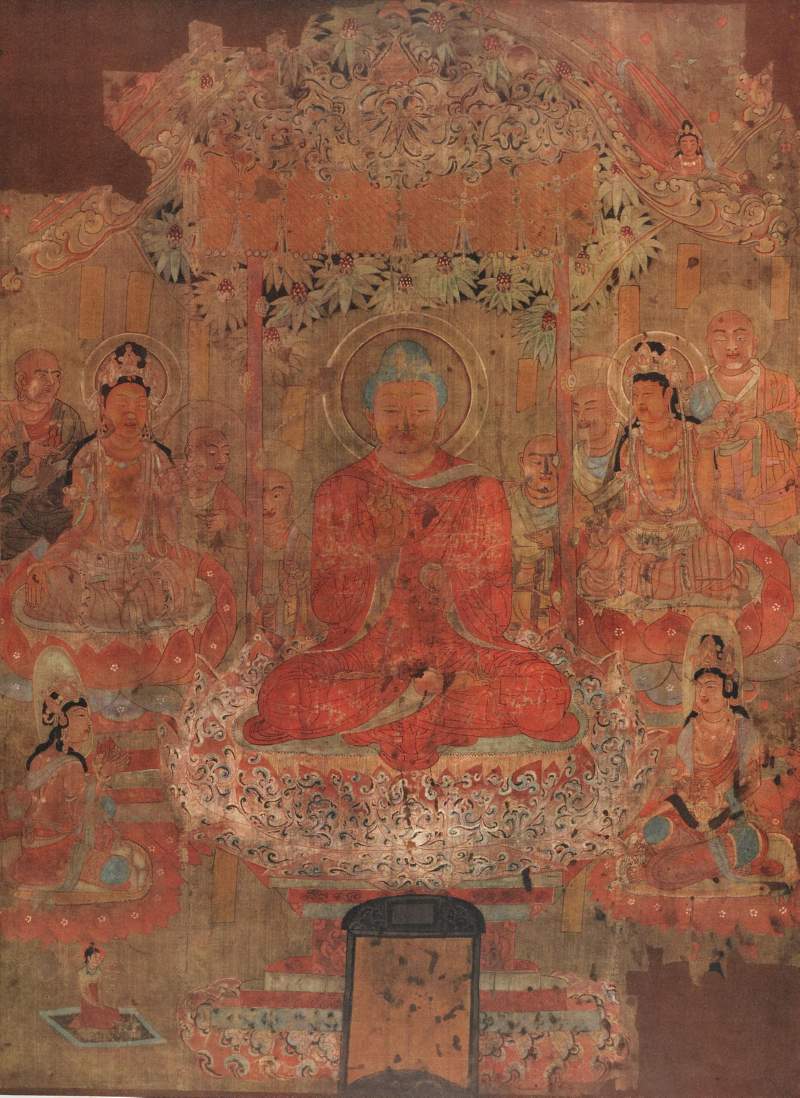
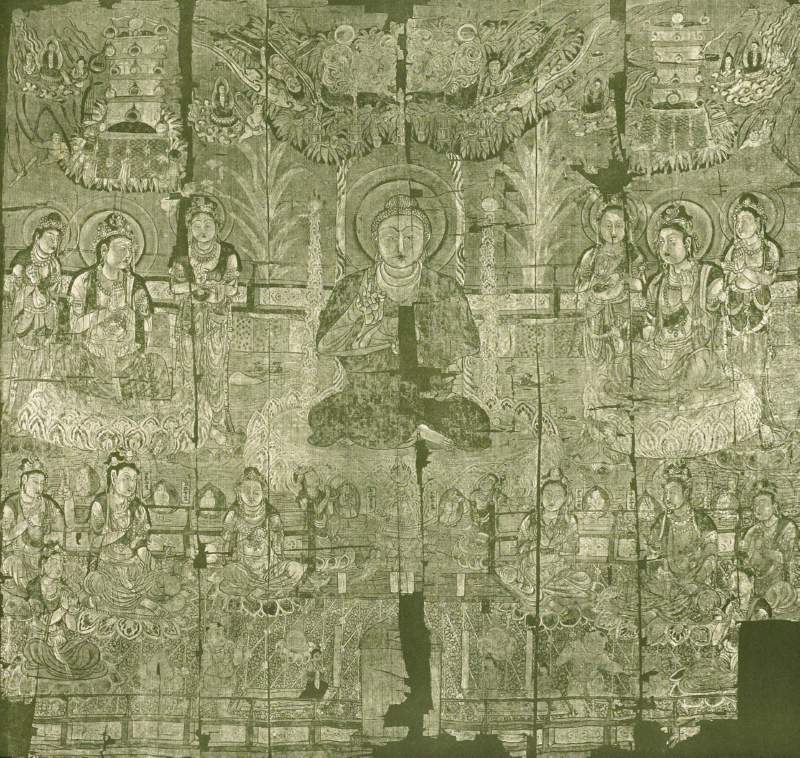
One of the finest of all the Tun-huang pictures is not a painting but a piece of embroidery. Unfortunately it does not lend itself well to photography in colour; and its quality and impressive character are merely suggested in the small Plate (Pl.
